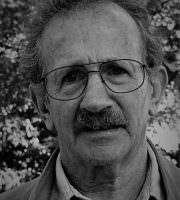
by Lyn Hejinian

Summers were spent in a fog that rains. They were mirages, no different from
those that camelback riders approach in the factual accounts of voyages in
which I persistently imagined myself, and those mirages on the highway
were for me both impalpable souvenirs and unstable evidence of my own
adventures, now slightly less vicarious than before. The person too has flared
ears, like an infant’s reddened with batting. I had claimed the radio nights for
my own. There were more storytellers than there were stories, so that everyone
in the family had a version of history and it was impossible to get close to the
original, or to know "what really happened." The pair of ancient, stunted apricot
trees yielded ancient, stunted apricots. What was the meaning hung from that
depend. The sweet aftertaste of artichokes. The lobes of autobiography. Even a
minor misadventure, a bumped fender or a newsstand without newspapers, can
“ruin the entire day,” but a child cries and laughs without rift. The sky droops
straight down. I lapse, hypnotized by the flux and reflux of the waves. They
had ruined the Danish pastry by frosting it with whipped butter. It was simply
a tunnel, a very short one. Now I remember worrying about lockjaw. The cattle
were beginning to move across the field pulled by the sun, which proved them
to be milk cows. There is so little public beauty. I found myself dependent on
a pause, a rose, something on paper. It is a way of saying, I want you, too, to
have this experience, so that we are more alike, so that we are closer, bound
together, sharing a point of view—so that we are “coming from the same place.”
It is possible to be homesick in one’s own neighborhood. Afraid of the bears. A
string of eucalyptus pods was hung by the window to discourage flies. So much
of “the way things were” was the same from one day to the next, or from one
occasion (Christmas, for example, or July 4th) to the next, that I can speak now
of how we “always” had dinner, all of us sitting at our usual places in front of
the placemats of woven straw, eating the salad first, with cottage cheese, which
my father always referred to as “cottage fromage,” that being one of many little
jokes with which he expressed his happiness at home. Twice he broke his baby
toe, stubbing it at night. As for we who “love to be astonished,” my heartbeats
shook the bed. In any case, I wanted to be both the farmer and his horse when I
was a child, and I tossed my head and stamped with one foot as if I were pawing
the ground before a long gallop. Across the school playground, an outing, a field
trip, passes in ragged order over the lines which mark the hopscotch
patch.
It made for a sort of family mythology. The heroes kept clean, chasing dusty
rustlers, tonguing the air. They spent the afternoon building a dam across the
gutter. There was too much carpeting in the house, but the windows upstairs
were left open except on the very coldest or wettest of days. It was there that she
met the astonishing figure of herself when young. Are we likely to find ourselves
later pondering such suchness amid all the bourgeois memorabilia. Whenever
I might find them, however unsuitable, I made them useful by a simple shift.
The obvious analogy is with music. Did you mean gutter or guitar. Like cabbage
or collage. The book was a sort of protection because it had a better plot. If
any can be spared from the garden. They hoped it would rain before somebody
parked beside that section of the curb. The fuchsia is a plant much like a person,
happy in the out-of-doors in the same sun and breeze that is most comfortable
to a person sitting nearby. We had to wash the windows in order to see them.
Supper was a different meal from dinner. Small fork-stemmed boats propelled
by wooden spoons wound in rubber bands cruised the trough. Losing its balance
on the low horizon lay the vanishing vernal day.
- Share this Poem: