
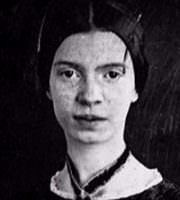
About Emily Dickinson
Emily Dickinson (1830-1886) was an American poet. Considered today one of the most important figures in English-language literature, she was virtually unknown during her lifetime. Only seven of her thousand short poems were ever published! The work that was published during her lifetime was usually altered significantly by the publishers to fit the conventional poetic rules of the time. Dickinson's poems were unique for the era in which she wrote. Many of her poems deal with themes of love, death and immortality.She was the daughter of the treasurer of Ainherst Academy in Massachusetts. Her life offers no remarkable events; a passive existence in a trivial environment, which Emily more than compensates for with the inner fervor reflected in her poems. These short pieces stem, in most cases, from concrete realities: the family home, which she left only four times throughout her life; her garden; domestic chores; the details she perceived through her window, her only opening to a closed world. Behind these seemingly tranquil appearances, through almost banal images and sometimes in the fleeting passage from one verse to another, one senses his yearning for life, a cautious fear of death, a smile that is not without irony, a search oriented towards an absolute concept of love, under whose contact one could experience those intense minutes of joy that the sight of a butterfly in a ray of sunlight sometimes provides.
The author's elliptical expression becomes even more striking in those instances where she undertakes something like a bold leap of intuition into new realities:
“Caress the coolness of the brow so feverish at times.
Lift, if you can, your indifferent hair.
Hold in your hand the diamond fingers.
They will never again wear a thimble.”
Browse all poems and texts published on Emily Dickinson
If I read a book and it makes my whole body so cold no fire can ever warm me, I know that is poetry.