
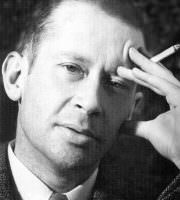
About E. E. Cummings
Edward Estlin Cummings (1894-1962) known as E. E. Cummings was an American poet, painter and writer. A soldier in France in 1917, he began his career with a novel about his war experience: The Enormous Room (1922). The following year, he published the first of his poetry books that would bring him fame, Tulips and Chimneys. Cummings is somewhat close to Dadaism and Surrealism, but stands out above all for his own qualities: he carried out incessant and profound work on language; he deconstructed syntax and grammar, invented new words through collage and other avant-garde experiments, skillfully manipulated slang, and worked on the visual aspect of the poem (typography, layout, etc.). His individualism has been criticized by some as much as it has been praised by others. Numerous epigones, attracted by the spectacular and seemingly easy side of these procedures, have ended up giving an unfaithful image of the master. His most important works are XLI Poems (1925), & (And) (1925), is 5 (1926), No, Thanks (1935), 1x1 (1944); EIMI (1933), a travelogue about his 1931 visit to the Soviet Union; Tom (1935); a book of memories, i — six nonlectures (1953); and a translation of the french poet work Aragón, Red Front.His complete works consists of nearly 2,900 poems, two autobiographical novels, four theatrical works, and several essays, along with numerous illustrations and paintings. He is celebrated as a prominent voice in the realm of 20th century English literature.
Browse all poems and texts published on E. E. Cummings
Cummings' poems often deals with themes of love and nature, as well as the relationship of the individual to the masses and to the world. His poems are also often rife with satire.