
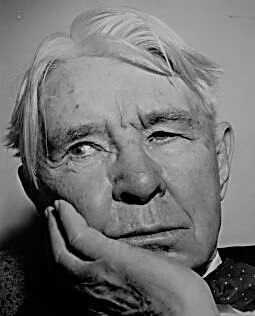
About Carl Sandburg
Carl Sandburg (1878-1967) was an American poet, historian, and novelist of Swedish origin. During his career, Carl Sandburg won the Pulitzer Prize three times: in 1919 for his collection “Corn Huskers”, in 1940 for his biography “Abraham Lincoln: The War Years”, and in 1951 for his collection “The Complete Poems of Carl Sandburg”. He was also awarded the Robert Frost Medal, a Grammy Award, and was the first white man to receive the NAACP Silver Plaque. He has left a great historical novel, “Rock of Remembrance” published in 1948. But he is best known as a leading figure of the Chicago School: Most of his poems, such as “Chicago” or “Clark Street Bridge”, have this city as a theme, which he knows particularly well from his work as a journalist-reporter at the Chicago Daily News and the Day Book.His work encompasses all the major themes related to North America, whether in his evocations of the Midwest, the simple and austere life of the rural world, or in his exaltation of the great industrial city. The titles of his books are, moreover, quite significant. These earthy themes are complemented by the idealistic humanism of Good Morning, America (1928) and The People, Yes (1936), where Sandburg extols the efforts of the working class.
During his lifetime, Sandburg was widely regarded as a major figure in contemporary literature, especially for volumes of his collected verse, including "Chicago Poems" published in 1916, Cornhuskers (1918), and Smoke and Steel (1920). He enjoyed unrivaled appeal as a poet in his day, perhaps because the breadth of his experiences connected him with so many strands of American life, and at his death in 1967, President Lyndon B. Johnson observed that Carl Sandburg was more than the voice of America, more than the poet of its strength and genius: He was America. Sandburg also wrote three children's books: Rootabaga Stories, in 1922, followed by Rootabaga Pigeons (1923) and Potato Face (1930).
Browse all poems and texts published on Carl Sandburg
Carl Sandburg described poetry as “an echo, asking a shadow to dance” and “the opening and closing of a door, leaving those who look through to guess about what is sent during the moment”