
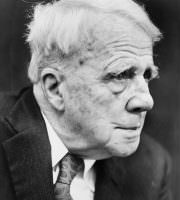
About Robert Frost
Robert Lee Frost (March 26, 1874 – January 29, 1963) was an American poet and four-time Pulitzer Prize winner. He is considered the most popular poet in the United States and is one of the most important poets of the 20th century, even if he cannot be clearly assigned to any modern literary movement. He was also a translator and playwright.On November 8, 1894, he published his first poem, entitled My Butterfly: An Elegy, which appeared on the front page of the New York Independent. In the next few years, he managed to publish another twelve poems in newspapers. In 1895, Frost married Elinor Miriam White, who became the greatest inspiration for his poems until her death in 1938. The couple moved to England in 1912 after their farm went bankrupt. A professor, unconvinced by the necessity of his profession, he left the United States the same year and moved to England. It was there that he began to interact with poets and published his first books: the success of A Boy's Will (1913) was confirmed in 1914 with North of Boston. Wartime circumstances forced him to return to his country a year later, and now, already well-known, he was invited to read his poems in various venues.
It was abroad that Frost met and was influenced by a number of contemporary British poets such as Edward Thomas, Rupert Brooke, and Robert Graves. While in England, Frost befriended the modernist poet Ezra Pound, who helped him promote and publish his work. By 1915, by the time of his return to the USA, Frost had already published 2 complete collections, with which his reputation was fully established. From then on, his publications followed one another, at his own pace, primarily singing the New England landscape: Mountain Interval (1916), New Hampshire (1923), West-Running Brook (1928), A Witness Tree (1942), A Masque of Reason (1945), Steeple Bush (1947), A Masque of Mercy (1947), and In the Clearing (1962). A poet of a region, Frost is in reality the poet of man and of the universe. For him, everything lent itself to wonder and understanding. But it is not God he finds: emptiness and absurdity are before us, opening up beneath our steps, and in the face of this, one can only be stoic and thus earn the nomination of man. For Frost, this evolution must also be based on humor.
In the 1920s, he was the most famous poet in the U.S.A. and with each new book, his fame, and honors grew. He also received the Congressional Gold Medal but never the Nobel Prize in Literature.
His works are primarily associated with the mystery, fear, and sacredness inherent in the wilderness and setting of New England natural life and landscapes; although he was a poet who used traditional forms and metrics, he remained detached from the literary movements and fashions of his time, describing himself as a neo-romantic. Frost is a precursor of the British Romantic poet William Wordsworth, immersed in the American metaphysical line of the transcendentalist Ralph Waldo Emerson, and of Emily Dickinson. He tends to go beyond what nature shows in the representation: he tends to the internal music of things, to their unveiling. His usual meter is free iambic, and the rhythm is in itself a representation, an image. Robert Frost was one of John Fitzgerald Kennedy's favorite poets—(to whom he wrote a poem for his presidential inauguration in 1961)—who sent him on a diplomatic-cultural mission to the USSR with Nikita Khrushchev. He was mentioned in Bernard Malamud's Dubin's Lives. Frost lived many years in Massachusetts and Vermont.
Robert Frost died in Boston, in a clinic, on January 29, 1963, of complications following prostate surgery for the removal of a malignant tumor, at the age of almost 89.
Browse all poems and texts published on Robert Frost
In three words I can sum up everything I've learned about life: it goes on.