
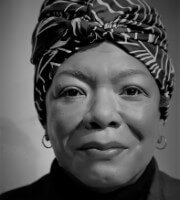
About Maya Angelou
Maya Angelou, formerly known as Marguerite Ann Johnson, was an African American poet, writer, dancer, singer, and actor. She changed her name following the recommendation of her managers when she was a dancer from 'Marguerite Johnson' or 'Rita' to 'Maya Angelou'. She was also increasingly successful as a singer and dancer and toured Europe from 1954 to 1955 with Porgy and Bess. Furthermore, she has traveled a lot, and she used her time in each country to acquire language skills. She speaks English, French, Spanish, Italian, and Arabic. As a dancer, she also participated in the world premiere of Max Roach's Freedom Now Suite. On May 28, 2014, she died peacefully in her home.The Power of Resilience: Exploring Maya Angelou Poems That Inspire
Maya Angelou's poems resonate with readers across generations and her words capture the essence of resilience and empowerment. Through her poetry, Angelou explores themes of identity, strength, and hope. Her texts continues to inspire and uplift and are celebrated for their lyrical beauty and powerful messages that encourages readers to find strength in their personal stories. By depicting her own challenges, Angelou inspires perseverance and hope in others. Every poem reflect her personal experiences and the broader African American experience. Her legacy endures, influencing new generations of poets and writers. Angelou's poetry remains a testament to the power of words to inspire change and resilience and her life was filled with trials, which she adeptly transformed into powerful poetical words, like “Still I Rise,” which speak to the indomitable spirit. Most of her verses illustrate how tenacity can overcome hardship and by portraying her daily struggles, Angelou offered hope to all those facing their own battles too. Her compelling texts become a beacon of enduring strength.Introduction to Maya Angelou's Poetry
Maya Angelou has been introduced to poetry by her teacher Bertha Flowers, who was a good friend to her family. She brought Maya various books and made her familiar with numerous authors, such as Charles Dickens, William Shakespeare, Edgar Allan Poe, Douglas Johnson, and James Weldon Johnson, but also with living African-American artists such as Frances Harper, Anne Spencer, and Jessie Fauset. In 1959, she met the writer John Oliver Killens, who persuaded her to move to New York City to focus on writing. She joined the Harlem Writers Guild, where she made contacts with major African-American authors such as John Henrik Clarke, Rosa Guy, Paule Marshall, and Julian Mayfield and published works for the first time.In her book 'I know why the caged bird sings', Maya quotes her teacher: 'You do not love poetry. You will never love her until you speak to her. Until she comes over your tongue, through your teeth, you'll never love poetry'. When 'I Know Why the Caged Bird Sings' was first published in 1969, Angelou was hailed as a new type of memoir authors, one of the first African-American women to be able to discuss publicly her personal life. According to academician Hilton Als, until then female authors of the Black race had been marginalized in such a way that it was impossible for them to present themselves as the central figure in the literature they wrote. Academician John McWhorter, on the other hand, considered Angelou works 'extensions' of tolerant writing'. He considered Angelou an advocate of Black culture. Angelou was particularly impressed by William Shakespeare and especially his sonnet 29. Angelou found herself in this sonnet again and again and again said: 'I thought: Shakespeare was a black girl'.
Maya Angelou's poetry is a profound exploration of life's truths. Her verses deliver timeless wisdom and emotional depth. In her work, Angelou weaves narratives that often center on themes of social justice and equality. Her influence extends far beyond poetry circles. Angelou's works are frequently studied in schools and universities across the globe. Her poetry, characterized by its rhythm and vivid imagery, continues to captivate audiences. Angelou wrote a total of seven autobiographies, with which her work is inextricably linked to her life, a story of survival despite having been the victim of racial segregation and multiple traumatic experiences. According to scholar Mary Jane Lupton, Angelou's third autobiography, Singin' and Swingin' and Gettin' Merry Like Christmas, published in 1976, marked the first time that a well-known African-American author wrote a third volume about his life.
Her books 'go beyond of time and space', from Arkansas to Africa and back to the United States, and are narrated from the beginning of World War II until the murder of Martin Luther King, Jr. Angelou published her seventh autobiography, 'Mom & Me & Mom' in 2013, at the age of 85. Throughout the process of writing her autobiography, Angelou became a recognized figure and highly respected spokesperson for African-Americans and women in general. She became, without any doubt, the most visible color autobiographer in the United States and a great voice of the autobiography of that time. Writer Gary Younge said: Probably to a greater extent than almost any living author, Angelou's life is literally her job. Angelou also wrote five collections of essays, which have been described as 'wisdom books' and 'homilies linked to autobiographical texts' by the writer Hilton Als. Exceptionally, Angelou had the same editor throughout her career, Robert Loomis, who was an executive editor of Random House; He retired in 2011 and has been considered 'one of the members of the publishers “hall of fame”. Angelou said the following about her long relationship with Loomis: 'We have a relationship that is famous among publicists'.
She was a prolific writer, and her poetry book 'Just Give Me a Cool Drink of Water 'Fore I Diiie' was nominated for the Pulitzer Prize, and she was chosen by President Bill Clinton to recite her poem 'On the Pulse of Morning' during his presidential inauguration in 1993. She is also known for 'Letter to my Daughter' published in 2008, which could be described as her spiritual testament.
Analysis of her Iconic Poems
Maya Angelou's poems resonate with many readers worldwide. Her ability to fuse personal narrative with universal truths is unmatched. Her iconic works inspire introspection, hope, and resilience for all who encounter them.Caged Bird stands as one of Angelou's most profound works. It symbolizes the universal longing for freedom against oppressive forces. This poem masterfully contrasts the free bird with the caged one, showcasing disparity and hope. Readers identify deeply with its message of perseverance. Key themes of this poem include: Freedom vs. restriction, Hope in adversity, The power of voice. By illustrating these themes, Angelou continues to inspire calls for equality and liberation.
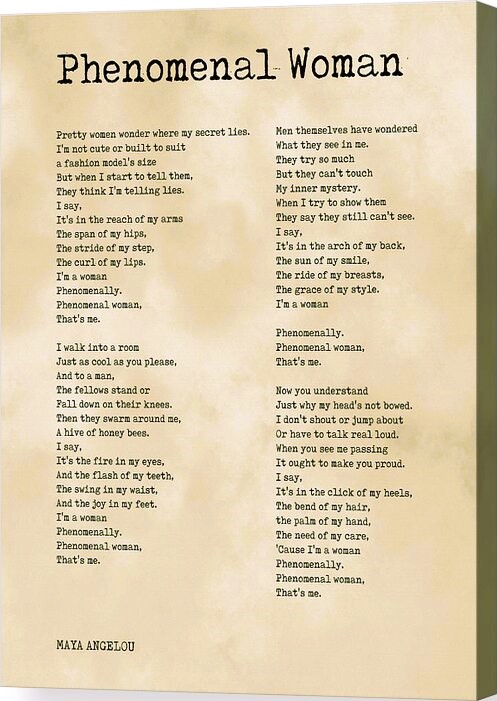
Phenomenal Woman celebrates the essence of confidence and strength. Angelou pays tribute to the grace and power of women, beyond superficial standards. The poem exudes warmth and invites all women to embrace their unique allure. With vivid imagery and rhythmic lines, Angelou's words encourage self-pride. This poem stands as a resonant anthem, uplifting women of all backgrounds. Its empowering message is timeless and universally inspiring.
Still I Rise is a bold declaration of resilience. Angelou crafts a narrative of triumph over oppression and adversity. With unwavering resolve, her words speak to overcoming injustice with dignity and pride. The poem's rhythmic refrain underscores its defiant tone. Rich with metaphors, “Still I Rise” asserts an indestructible spirit. Angelou's powerful verses remind readers of their potential to rise, regardless of circumstances. This message endures as a source of unwavering inspiration.
The Journey of Self-Discovery
Self-discovery is another prominent theme in Angelou's poetry. Through introspective writing, she explores identity and empowerment. Her poems encourage readers to embrace their true selves. They highlight the importance of understanding one's history and place in the world. Angelou's work provides a roadmap to self-acceptance and personal growth. Her insights continue to guide and uplift.In 1960, Maya Angelou first heard of and met the civil rights activist Martin Luther King. She then co-organized with Killens the 'Cabaret for Freedom' in favor of the Southern Christian Leadership Conference (SCLC), after which she was named Northern Coordinator.
In 1961, as an activist, she went to Africa with the South African freedom fighter Vusumzi Make. She first lived in Cairo and worked for the English-language newspaper The Arab Observer. After separating from Make in 1962, she moved to Ghana with her son, Guy, and worked until 1965 at the University of Ghana. She was also an editor for The African Review and a freelance journalist for the Ghanaian Times. The experience of these years from 1957 to 1962 is particularly described in her autobiographical volume, The Heart of a Woman. The title of this book was taken from a poem by Georgia Douglas Johnson, a representative of the Harlem Renaissance.
Influence on Modern Literature
Angelou's influence on modern literature cannot be overstated. Her unique voice and lyrical mastery have inspired countless writers to explore similar themes of identity and empowerment. By challenging societal norms, Angelou paved the way for a diverse array of voices in literature, leaving a lasting legacy in her wake. Angelou's poetry is rich with inspirational lines that resonate deeply. Her words are frequently quoted for their profound wisdom and strength. Some notable quotes include: “You may shoot me with your words.”, “I'm a woman phenomenally, phenomenal woman, that's me.” These messages encourage self-belief and resilience, offering hope to those who encounter them.Browse all poems and texts published on Maya Angelou
The most popular of her best and famous poems: I Know Why the Caged Bird Sings, recites a part of her difficult adolescence and racist attacks in Arkansas.