
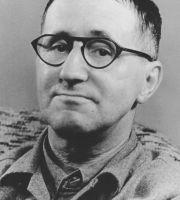
About Bertolt Brecht
Bertolt Brecht (1898-1956) was a German poet and dramaturge, born in Augsburg, where his father was the director of a paper factory. As a medical student, he supported the Bavarian Revolution in 1919. He abandoned his studies and settled in Munich, where he devoted himself to theater, journalism, and music. He soon joined the Expressionist movement and began writing poems inspired by anarchism and nihilism. A convinced pacifist, he composed the poem The Legend of the Dead Soldier, a work for which Hitler included him on the blacklist that was executed at the time of the failed coup of 1923. The following year, after marrying, he settled in Berlin, where he undertook the task of bringing theater and music to the people. A staunch enemy of National Socialism, he was forced to flee with his second wife, Ellen Weigel, the day after the Reichstag fire on February 28, 1933. A refugee successively in Prague, Vienna, Zurich, Paris, and Denmark, he was stripped of his nationality in 1935. In 1939, the advance of German troops forced him to leave Denmark; he then lived in Sweden, Finland, and finally in the United States. In 1947, questioned by the House Un-American Activities Committee, he moved to Switzerland. After performing Mother Courage in Berlin in 1949, he settled there and founded his theater company, the Berliner Ensemble. His relations with the communist regime were rather turbulent: in 1954, he was appointed to the artistic council of the Ministry of Culture; In 1956, he published a Carla to the Bundestag in Bonn, in which he criticized the rearmament of West Germany, but he did not hesitate, however, to criticize the repression that followed the uprising in East Berlin in 1953. He died on 14 August 1956, at the age of fifty-eight.Bertolt Brecht's dramatic work is considerable, both for the quantity of his plays written and for the renewal and influence it has exerted on subsequent theater. From his beginnings as a playwright, Brecht—following the expressionist poetic experience manifested in Mother Courage and Her Children and The Private Life of the Master Race, with its trivial, even obscene language—strove to cast a lucid gaze upon the modern world, freed from the excesses of passion. With Wedding of the Lower Bourgeoisie (1919), the first version of Baal (1920), In the Jungle of the Cities (1922), and Drums in the Night (1922), he distanced himself from expressionism, proscribing the mixture of passivity and compromise that characterized this movement. As Fredric Jameson points out in his Brecht Method, some of the innovations proposed by the Brechtian stage are similar to those proposed by important modernist artists in theater or other arts. Notable among these are the dramaturgy of Frank Wedekind, an influence acknowledged by Brecht himself; James Joyce's novel Ulysses; Mayakovsky's Cubo-Futurist proposals; Sergei Eisenstein's Constructivist cinema; and, most importantly, the postulates of theater director Meyerhold and the collage techniques in Picasso's works.
Browse all poems and texts published on Bertolt Brecht