
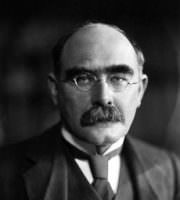
About Rudyard Kipling
Rudyard Kipling (1865-1936) was an English poet and writer. Born in Bombay into a cultured family (his father would later become assistant director of the Lahore Museum), Kipling lived in England from the age of six to seventeen: these were his student days, which he later recalled in his novel Stalky & Co. (1899). Upon his return to India, he worked as a journalist, which allowed him to acquire exceptional knowledge of the country. He became known in 1887 with the publication of Plain Tales from the Hills. A year later, he returned to England and later settled in the United Kingdom (1892-1897), where he married. The first and second Jungle Books date from this period. In 1897, he settled permanently in England; already then, he was known as a poet for his Barrack-Room Ballads (1886). He soon became known as the Bard of Empire or Laureate of the Empire for his literary works that supported British imperialism; certainly, Kipling celebrated the White Man's Burden across the seas in numerous of his poems, but in his Recessional (1897) he also issued a warning to his contemporaries, prompted by his own nationalist outburst. Until his death, Kipling continued to write for young people. His best-known titles are his novel *Kim* (1901) and *Thoughts Like That* (1902) which refers to the advice in his famous poem *IF*. The ideal he portrays in these stories has sometimes led them to be considered puerile, but in them one can appreciate, in addition to an undeniable ability to create a dense and forceful style, a sense of mystery and psychological insight such that they place Kipling among the best Anglo-Saxon short story writers.To fully understand Kipling, it is necessary to read his autobiography, published after his death and modestly titled Something About Myself. An autobiography that helps uncover his intimate tragedies (the death of his eldest daughter in 1899; that of his son in the war in 1915) and removes the mask of the Singer of Imperialism that has so harmed him. He was the first English writer to receive the Nobel Prize for Literature, in 1907.
Browse all poems and texts published on Rudyard Kipling
In a 1995 BBC opinion poll, it was voted the UK's favourite poem.