
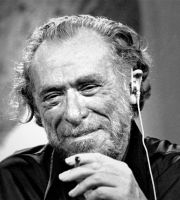
About Charles Bukowski
Charles Bukowski was a one of the famous poets of the Pulp Generation. Born Heinrich Karl Bukowski on August 16, 1920 in Andernach, Germany and died on March 9, 1994 in Los Angeles, United States, He was an American poet and writer of German origin, author of novels, short stories and poetry. He is known by his various pseudonyms: Hank, Buk, Henry Chinaski, the latter being that of his alter ego in his numerous autobiographical novels. He is the author, in prose as well as in verse, of a considerable poetic work. While his love and professional life was chaotic, he continued to delve into literature, and discovered classical music (Gustav Mahler would never leave him), while continuing to write poems and autobiographical works.His life then revolved around a dingy hotel room, an uninteresting job that only served to feed himself—the feudal relationships between managers and employees fueled Bukowski's writing—and the quest for alcohol and women to forget everything. Bukowski, at 25, had already become a drunkard, sexually obsessed, unstable, and leading a chaotic life. He left for New York, but the experience was quite difficult. Disillusioned, he returned to Los Angeles, contemplated suicide, and stopped writing for about ten years.
At 26, he met Jane Cooney Baker in a bar. A woman ten years his senior, ravaged by alcohol, with an even more chaotic background than his own. They remained together for about ten years. He was hired by the post office in 1952, for a few weeks, he thought, while he waited to make a living from his writing. He stayed there for three years. His literary ambitions were still at a standstill: although he managed to publish a few poems and columns in underground magazines, and a booklet, Twenty Tanks from Kasseldown, (Black Sun Press, 1946), nothing substantial allowed him to leave his job as a postman. Despite these material contingencies, he continued to depict everyday infamy, exploited the vein of his experience as a postman, and drank ever more. He developed an ulcer, was banned from drinking, and during this time discovered horse racing, his other great passion. Jane, however, continued to drink. Her health declined, and their relationship deteriorated; they eventually broke up.
He then published poems for the first time in a small magazine, whose editor-in-chief he ended up marrying, Barbara Frye, a Texan, daughter of wealthy landowners, who adored the talent she perceived in Bukowski. They remained together for two years, before Bukowski left her, exasperated by her mood swings and temper. He returned to Los Angeles. Small publications followed in more or less obscure magazines, and Bukowski's name began to make its mark. A first collection appeared, and Bukowski was invited to frequent literary circles, writers, and publishers. He abandoned the scene. He was published in The Outsider, a more widely distributed magazine, alongside Allen Ginsberg, Jack Kerouac (who had just published On the Road), and William Burroughs. As his popularity grew, he was invited to lecture at universities.
In 1969, his first major collection of short stories and columns appeared, entitled Diary of a Dirty Old Man, courageously published by Lawrence Ferlinghetti, a Beat Generation poet and editor in San Francisco, who would continue to work for Charles's artistic recognition. This book brings together tales of debauchery described in his column, Notes from a Dirty Old Man, which appeared in Open City, the Los Angeles Free Press, and Nola Express in New Orleans. In 1972, he published his work in the underground newspaper Nola Express with Hedwig Gorski. The collection, with a print run of 20,000 copies, achieved critical acclaim within the Beat scene. This quickly led to his being associated with the movement, a claim he categorically denied. Bukowski never knew the members of the Beat Generation, nor did he embrace the hippie philosophy; at most, he encountered William S. Burroughs much later. This publication corresponds to the first public readings of his poems by himself, most often in university student councils, small literary circles, and bars. He gets drunk before each stage appearance, and, dead drunk, spouts as many insults as poetry.
In 1966, John Martin founded Black Sparrow Press with the goal of publishing Charles Bukowski and other avant-garde artists. For the first time in his life, he was able to devote himself to writing. He quit his job at the post office. His poetry collections continued to be published. He published his first novel, The Postman (1971), in which he depicted his daily life as a postal worker. The 2,000 copies sold quickly.
Browse all poems and texts published on Charles Bukowski
His poetry was influenced by the social, cultural, and economic ambience of his home city of Los Angeles.