
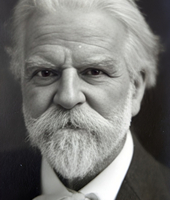
About Edwin Markham
Charles Edward Anson Markham (April 23, 1852 – March 7, 1940) was an American poet. From 1923 to 1931, he was poet laureate of Oregon. Markham was born in Oregon City, in the Oregon Territory, but his mother took him to a farm at Suisun, California, in 1856. The farm was halfway between Sacramento and San Francisco; Markham lived in California, where he became a schoolteacher, until moving to New York’s Staten Island at the turn of the century, and publishing a number of volumes of poetry thereafter.Edwin Markham's most famous poem, “The Man With the Hoe” (1899), which focuses on the hardships of working-class people, was first performed at a public poetry reading in 1898. Markham's poem was published and quickly became popular. “The Man With the Hoe” was reprinted repeatedly across the country; it galvanized farmers’ awareness of the economic grievances they had against banking and industry, and became one of the signature poems of the labor movement. It would eventually appear in 10,000 newspapers in more than forty languages. His poem “Lincoln, the Man of the People” was published in almost every American newspaper in 1900. The late Victorian illustrated version of “The Man With the Hoe” included in the appendix was published as a special supplement to the San Francisco Examiner, the place the poem first appeared, after it became famous. The original is in the editor’s collection.
Prior to issuing “The Man With the Hoe,” Markham had published “Song of the Workers” in William Morris’s London journal Commonweal, and had written a number of conventionally romantic poems. But he was also reading Karl Marx (1818–1883) and other socialist writers and becoming radicalized. “The Man With the Hoe” is an explicit response to an oil painting by the French artist Jean Francois Millet, one of several paintings on contemporary agricultural, working-class subjects Millet produced at the middle of the nineteenth century. It depicts a rough-shod farmer or agricultural worker, probably exhausted and certainly leaning forward on his hoe, in a flat scrub landscape as yet untamed and unplowed. Markham’s poetic response is effective in marshalling moral outrage and linking it to literariness on workers’ behalf. Its indictment of the ravages wrought by those in power was decisive for its time, in part because Markham treated exploitation as a violation of God’s will. The poem is equally effective in issuing a broad revolutionary warning to capitalists and politicians. The version printed here was slightly revised by Markham in 1920.
In 1922, Markham's poem "Lincoln, the Man of the People" was selected from 250 entries to be presented at the dedication of the Lincoln Memorial. The author himself read the poem. Dr. Henry Van Dyke of Princeton said of the poem, "Edwin Markham's Lincoln is the greatest poem ever written about the immortal martyr, and the greatest that will ever be written." Later that year, Markham was filmed reciting Lee De Forest's poem using his Phonofilm process.
Throughout Markham's later life, many readers considered him an important voice in American poetry, a position signified by honors such as his 1908 election to the American Academy of Arts and Letters. Despite his many accolades, however, neither of his later books achieved the success of his first two. In New York, he gave numerous lectures to working-class groups. His 1904 edition of the works of Edgar Allan Poe was followed by several volumes of The Real America in Romance, published from 1909 to 1927 by the New York publisher W. H. Wise. His edited works include several collections of British and American poetry.
Browse all poems and texts published on Edwin Markham
There is a destiny which makes us brothers; none goes his way alone. All that we send into the lives of others comes back into our own.