
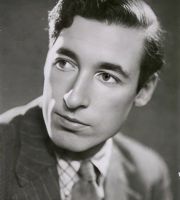
About Louis MacNeice
Frederick Louis MacNeice (Belfast, 12 September 1907 – London, 3 September 1963) was a poet and playwright of both Northern Irish and British heritage. His first book of poems, Blind Fireworks, appeared in 1929. Known for his respect for humanist values and his opposition to all forms of totalitarianism, he consistently reaffirmed his loyalty to his Irish roots. Louis MacNeice belonged to a circle of poets gathered in the 1930s around W. H. Auden, which primarily included Christopher Isherwood, Stephen Spender, Cecil Day-Lewis, and occasionally Rex Warner and Edward Upward. This “Auden Group” was nicknamed the “MacSpaunday Group” by virtue of a kind of acronym coined by the South African poet Roy Campbell. Imagining a composite entity formed by four of them, Campbell played on their names: MACNeice, SPender, AUden, Day-Lewis.His poetry, his plays for BBC radio—whose only equivalents can be found in the works of Dylan Thomas or Heinrich Böll and his radio plays—and his prose, though seemingly simple, are complex and erudite. A great translator of Goethe (both Faust plays) and Aeschylus (Agamemnon), he seemed out of place in his century, even though he sought to liberate the poetry of his time from its classicism, to let in the sounds of life and the world. His entire oeuvre appears as a kind of quest, and also as a bitter lucidity about humanity and its rituals: marriage, war… His stylistic virtuosity, his biting irony, his sometimes ponderous erudition, his hedonism in opposition to the cruelty of the world, make him a writer who remains either contested or admired. Two poems are staples of most English-language memoirs: “Autobiography” and “Prayer before birth.” There are others just as powerful, just as bitter, that should be read just as intensely. T.S. Eliot considered him a poet of genius.
Browse all poems and texts published on Louis MacNeice