
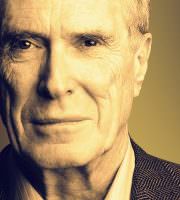
About Mark Strand
Mark Strand (April 11, 1934 – November 29, 2014) was a Canadian-born American poet, essayist and translator. He was appointed Poet Laureate Consultant in Poetry to the Library of Congress from 1990 to 1991. Mark Strand was recognized as one of the premier American poets of his generation as well as an accomplished editor, translator, and prose writer. He was a professor of English and Comparative Literature at Columbia University from 2005 until his death in 2014. Strand has received numerous awards, including a MacArthur Fellowship in 1987 and the Pulitzer Prize for Poetry in 1999 for Blizzard of One.Strand’s childhood was characterized by great geographic moves. He was born of American parents on Prince Edward Island, Canada, and his father’s job as a salesman took the family from Canada to New York, Cleveland, Philadelphia, Peru, and Mexico before Strand went off to Antioch College and then Yale, intent on becoming a painter. By the age of twenty, he had begun to write poetry seriously and went to Italy on a Fulbright scholarship to study nineteenth-century Italian poetry.
In addition to his twelve acclaimed volumes of poetry, Strand has published translations from the Spanish and the Portuguese, fiction, children’s books, and works of art criticism, including a monograph on Edward Hopper, whose paintings influenced Strand’s early windswept brand of American surrealism. “When I was a child, what I saw of the world I saw from the backseat of my parents’ car,” Strand writes of his kinship with Hopper. “It was a world beyond my immediate neighborhood glimpsed in passing. It was still. It had its own life and did not know or care that I happened by at a particular time. Like the world of Hopper paintings, it did not return my gaze.”
The rootless speakers in Strand's first three volumes move through empty landscapes that are charged with erotic melancholy. But they often look out upon their bleak surroundings with humor, seeming to shrug at the world’s indifference and unpredictability. In the seventies, his verse became more intimate and parents, wives, and children populated his poetry. He reflects on this period as being his most imitative:“Lots of poets I admired were writing about their childhoods, so I wanted to be a member of the childhood club. But I discovered I didn’t have much gift for it. Nor could I sustain an interest in it.” His laureate year followed a mid-career period of transition; his seventh book, The Continuous Life, had just been published following a decade-long period of poetic silence during which he wrote fiction and art criticism.
Strand’s recent writing often praises the physical world: the sun on our faces, a lover undressing and slipping into bed, a woman’s reflection in a gilt-framed mirror, the day’s first cup of coffee, a well-cut sports coat worn with jeans. His mature poetry is suffused with subtle emotion: “I look to be moved, to have my view of the world in which I live somewhat changed, enlarged. I want both to belong more strongly to it or more emphatically to it, and yet, to be able to see it, to have—well, it’s almost a paradox to say this—a more compassionate distance.”
Browse all poems and texts published on Mark Strand