
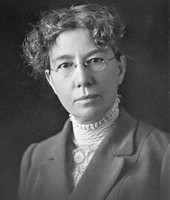
About Mary Gilmore
Mary Gilmore (16 August 1865 – 3 December 1962) was an Australian journalist and poet. Her socially engaged poetry was influenced by William Baylebridge and is characterized by warmth and humanity. On 1 February 1937, she was awarded a Dame Commander, the second-highest degree of the Order of the British Empire. Since 1985, the Association for the Study of Australian Literature (ASA) has awarded the Mary Gilmore Award for the first volume of poetry by an author. Gilmore's portrait and excerpts from her writings have appeared on the Australian $10 note since 1993. Gilmore Crater is also named in his honor.Gilmore's first volume of poetry was published in 1910, and over the next fifty years she was regarded as one of Australia's most popular and widely read poets. In 1908, she became editor of the women's section of The Australian Worker, the newspaper of Australia's largest and most powerful trade union at the time, the Australian Workers' Union (AWU). She was the first woman to become a member of the union. Through The Worker, she had a platform for her journalism, through which she fought for the preservation of the White Australia policy, for better working conditions for women, for the welfare of children, and for more equal treatment for Aboriginal Australians. Before 1940, she published six volumes of poetry and three collections of prose. In 1940, she wrote the poem "No Foe Shall Gather Our Harvest," a morale booster for Australian soldiers and citizens during World War II.
Mary Gilmore died in 1962 at the age of 97 and received a state funeral, the first time a writer had been accorded a state funeral since Henry Lawson's death forty years earlier.
Browse all poems and texts published on Mary Gilmore