
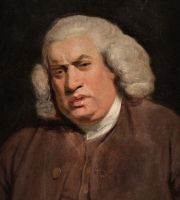
About Samuel Johnson
Samuel Johnson (also known as “Dr. Johnson”), born on September 18, 1709, and died on December 13, 1784, is one of the leading figures in British literature. A poet, essayist, biographer, lexicographer, translator, pamphleteer, journalist, editor, moralist, and polymath, he was also a highly regarded literary critic. His first works were the biography of his friend, the poet Richard Savage, The Life of Mr Richard Savage (1744), the poems London and The Vanity of Human Wishes and a tragedy, Irene. London, his first major poetic work, was published anonymously in May 1738. Inspired by Juvenal's Third Satire, it features a man named Thales departing for Wales to escape the troubles of London, described as a place of crime, corruption, and abandonment of the poor. Johnson did not expect the poem to reveal its worth, although Alexander Pope declared that the author would soon be unearthed, but this would not happen for another 15 years. His most highly regarded poem, The Vanity of Human Wishes, was written with such “extraordinary speed” that Boswell asserts that Johnson “should have been a perpetual poet”. It is an imitation of Juvenal's Satire X, which states that “the antidote to futile human wishes is non-futile spiritual wishes”. More specifically, Johnson underlines “the helpless vulnerability of the individual in the face of social context” and “the inevitable blindness by which human beings are led astray”. The poem, though critically acclaimed, was not a popular success and sold less well than London. In London, Johnson uses poetic form to express his political views and, as young authors often do, takes a playful and almost joyful approach to the subject. His second imitation, The Vanity of Human Wishes, is entirely different: while the language remains simple, the poem is more complicated and difficult to read, as Johnson attempts to depict complex Christian morality.However, it was on The Plays of William Shakespeare that Johnson spent most of his time. On June 8, 1756, he published his Proposals for Printing, by Subscription, the Dramatick Works of William Shakespeare, which argued that previous editions of Shakespeare were full of errors and that corrections were necessary.
The fearsome “Doctor Johnson” had an extraordinary physical presence. As P. Dottin wrote, “This large, scrofulous, one-eyed, half-deaf man, with a hunched back, a foul temper, a tavern oracle, impressed the poets and artists who gathered around his throne with the brutality of his judgments and his great erudition.” His literary personality is less interesting: an adherent of the most orthodox classicism, Johnson left us some tedious tragedies, an oriental tale of little originality “The History of Rasselas, Prince of Abissinia”, an edition of Shakespeare in which he accuses this great writer of immorality and irregularity, a collection of “Lives of the Most Eminent English Poets”, and a copious Dictionary to “preserve the purity and clarify the meaning of the English language.” Johnson's masterpiece is undoubtedly his own life, at least as presented by his friend Boswell (1740-1795): The Life of Samuel Johnson (1791) is one of the customs of the biographical genre.
Browse all poems and texts published on Samuel Johnson
Johnson believed that the best poems used contemporary language, and he disapproved of the use of ornamental or deliberately archaic language. In particular, he distrusted Milton's poetic language, whose blank (unrhymed) verse he thought could inspire poor imitations. Johnson also criticized the poetic language of his contemporary Thomas Gray. Above all, he was bothered by the overuse of obscure allusions of the kind found in Milton's Lycidas; he preferred poetry that could be easily read and understood. In addition to his remarks on language, Johnson believed that a good poem should contain unique and original imagery.