
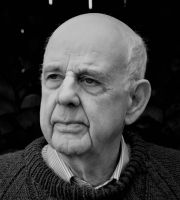
About Wendell Berry
Wendell Berry (born August 5, 1934, in Henry County, Kentucky and died August 31, 2026 in Port Royal, Kentucky) was an American writer, essayist, farmer, novelist, poet, professor, and critic. Berry authored more than 40 works of fiction, essays, and poetry and received numerous prizes and awards, including the 2010 National Humanities Medal, presented by President Barack Obama, and the 2013 Dayton Literary Peace Prize. He is a Fellow of the American Academy of Arts and Sciences and was elected to the American Academy of Arts and Letters in 2014.Wendell Berry's work reflects his concerns, primarily centered on agriculture and community. It reveals his love of the land as well as his family, community, ecological, and humanist values. While chronicling and critiquing the decline of rural life in America and what he calls the global “cultural disorder,” his work also promotes awareness, attentiveness, individual responsibility, and the harmonization of the relationship between humankind, nature, and the natural world. The author has even been hailed by the New York Times as “the prophet of rural America.” Deeply ethical, spiritual, intimate, and practical, Wendell Berry's work focuses primarily on the health of the world. Berry made his critical stance towards technology public as early as 1987, when he explained in an essay in Harper’s Magazine why he didn’t want to buy a computer (“Why I Am Not Going to Buy a Computer”): “As a farmer, I work almost exclusively with horses. As a writer, I work with pen and paper… How could I consciously write against the rape of nature if, in the act of writing, I myself would be participating in that very rape? For the same reason, it is important to me to write in daylight and without electric lighting.”
In 2020, Wendell Berry and his wife, Tanya Berry, filed a lawsuit against the University of Kentucky to prevent the removal of a mural painted on the university grounds. The mural was painted in 1934 by Tanya Berry's aunt, Ann Rice O'Halon. It juxtaposes scenes of free white men and women with vignettes of enslaved Black people working in a field. Deeming the work racist, the administration had decided to remove it. The Berrys argue that, on the contrary, it is a faithful representation of historical reality.
Browse all poems and texts published on Wendell Berry
We have lived our lives by the assumption that what was good for us would be good for the world. We have been wrong. We must change our lives so that it will be possible to live by the contrary assumption, that what is good for the world will be good for us. And that requires that we make the effort to know the world and learn what is good for it.