
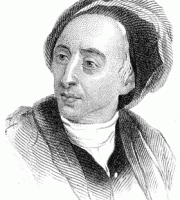
About Alexander Pope
Alexander Pope (21 May 1688, Lombard Street, London — 30 May 1744-Twickenham) was a romantic 18th-century English poet and translator. He is best known for his satirical verse, as well as for his translation of Homer. Pope's most famous poem is The Rape of the Lock, and his best-known work is The Dunciad. He is also famous for his use of the heroic couplet, he is the third-most frequently quoted writer in The Oxford Dictionary of Quotations, after Shakespeare and Alfred Tennyson. Amazingly precocious, he composed Pastorals at the age of sixteen. A Catholic, he was unable to enter university, but his classical culture was very solid, and during his adolescence, spent near Windsor Forest, he devoted himself tirelessly to study.In 1711, he became known with his Essay on Criticism. His first masterpiece was The Rape of the Lock (1712-1714), a burlesque poem in which a drawing-room joke (Lord Peter had cut a lock of Miss Araball Fermor's hair) serves as a pretext for a humorous dissertation. His translations of Homer enriched Pope, who was able to live completely independent in Twickenham from then on. It was there that he gave free rein to his prodigious satirical streak. “The Wasp of Twickenham” — as he was called — taunted his enemies, especially in The Dunciad (1728) and The New Dunciad (1743). His verse Epistles were and are equally celebrated: “Pope was the first who expressed in verse, in a form elegant and correct enough to please all tastes, impersonal enough to please all minds, ideas that were widespread for at least a century: deism, optimism, classicism” (Paul Van Tieghem). A master of verse, he even poeticized the philosophical theories of his friend Bolingbroke in his Essay on Man.
Browse all poems and texts published on Alexander Pope