
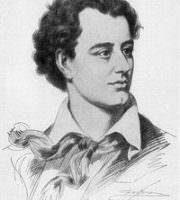
About Lord Byron
George Gordon Byron, usually called Lord Byron (22 January 1788 in London — 19 April 1824 in Missolonghi, Greece) was a British poet. He is one of the most illustrious poets in the history of English-language literature. Although classical in taste, he represents one of the great figures of English Romanticism. He was born into a noble but impoverished family. From childhood, he faced a double obstacle: physical (he was lame) and financial (his father was gradually ruined). He slowly overcame his physical disability and eventually became an attractive dandy. When he inherited the title of lord, he could no longer afford the family's expenses and moved to Southwell. He enrolled at Trinity College, Cambridge, and published Hours of Idleness (1807), a collection of rather conventional exercises and attempts. The following year, he published Scottish Bards and Critics, a satirical work in which he attacked British literary circles. In 1809, he began writing "Childe Harold's Pilgrimage", a kind of poetic diary in which he recounts the most significant events of his life and reveals the different moods he experienced. He completed the first two volumes in 1810; the next two were written between 1816 and 1817.The same year, he embarked on a long journey through Portugal, Spain, Albania, Greece, and Turkey. These two years of wandering had a great influence on him, giving him a sense of local color and awakening his political conscience as he witnessed the oppression of nationalisms. Upon his return, he published The Curse of Minerva, a satirical work in which he denounced the cultural plundering of Greece. He also participated in parliamentary debates: in the House of Lords (holding a seat for the Whig party) he delivered three speeches; Two of them, especially the one concerning Irish Catholics, stirred up a great deal of controversy and led to Byron being considered a left-wing extremist. 1812 marks a turning point in Byron's life, with the publication of the first two cantos of Childe Harold. The enormous success of this work was due, above all, to the taste for the Orient and the exotic, its tourist references, and, even more so, to the philosophical meditation it develops. For five years, Byron would continue to exploit this vein, publishing a series of poems that would increase his fame: The Infidel, The Bride of Abydos, Lara, The Corsair, etc. Already in these compositions—and parallel to his lyrical inspiration—his narrative talents begin to emerge, later solidified in The Siege of Corinth, Parisienne, The Prisoner of Chillon, and The Island, which recounts, in verse, the adventure of the mutineers on the Bounty. Around this time, he also began keeping a series of personal diaries, among which the entries of 1813 and 1821 stand out. In 1815, at the request of the Jewish community of London, he wrote Hebrew Melodies (inspired by the Bible and later murmured by Isaac Nathan). It was during this period that he met Ann Isabella Milbanke, a wealthy Wentworth heiress. The young woman's family opposed the marriage; but Byron managed to improve his financial situation and marry her in 1815, although this union would be very short-lived: after the birth of a daughter, they separated the following year, and the poet went to Switzerland. It was there that he composed the third canto of Childe Harold. Byron also ventured into theater, composing Manfred, a dramatization with clear influences from Goethe, which reflects the moral crisis the author was experiencing at that time. To this piece—intended more for reading than for performance—seven more dramas would be added over time: Vermeer, Marino Faliero (1820), Sardanapalus (1821), The Two Foscari (1821), Cain (1821), and Heaven and Earth (two pieces with abundant philosophical features), and The Deformed Transformed (1824), which, revisiting the theme of Second Faust, draws on the author's own experience. He then departs for Italy. For two years, he leads a turbulent life in Venice. In 1817, he completes the fourth canto of Childe Harold, a philosophical and touristic journey that, through Latium, takes him to Rome. At the same time, he writes Beppo, a bawdy tale inspired by Boccaccio. In 1818, he finished the first two cantos of his Don Juan, a work that blends satire and humor, generally burlesque in tone (between this year and 1820 he would write the remaining three cantos). He then moved to Ravenna, where he met Teresa Guiccioli, with whom he experienced a brief period of happiness. He resumed his political activity and participated in the Carbonari movement. He also resumed writing Don Juan, of which he wrote twelve cantos between 1822 and 1823. He then conceived The Age of Bronze, a clearly politically engaged work in which he railed against England's policies, based on self-interest. But fighting with words is insufficient, and the poet aspires to action: at first, he plans to join Bolívar in America, but ends up going to Greece in 1823 with the mission of organizing the material aid sent to the insurgents. He dedicates himself ardently to this task for three months, managing to establish order and trust among the ranks of the combatants. Admired almost as a hero, he is about to become a lieutenant general (and perhaps one day king of liberated Greece) when he dies in Missolonghi, struck by fever, at the age of thirty-six. He had still had time, however, to write one last poem on the occasion of his birthday, a kind of testament in which he bids farewell to this life, but with hope set on another, much purer existence.
Among Byron's best poetry works are the lengthy narrative poems "Don Juan" and "Childe Harold's Pilgrimage" and the short popular poem "She Walks in Beauty". Byron's magnum opus, Don Juan, a poem spanning 17 cantos, ranks as one of the most important long poems published in England since John Milton's Paradise Lost. The masterpiece, often called the epic of its time, has roots deep in literary tradition and, although regarded by early Victorians as somewhat shocking, equally involves itself with its own contemporary world at all levels — social, political, literary and ideological. This is a list of the best poems and romantic poetry verses of this great author.
Browse all poems and texts published on Lord Byron
Words are things, and a small drop of ink, Falling, like dew, upon a thought produces. That which makes thousands, perhaps millions think.