
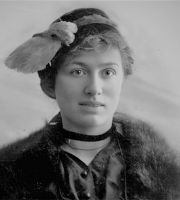
About Edith Sodergran
Edith Södergran was a Finnish poet who wrote in Swedish. She is considered one of the greatest Nordic poets of the 20th century. Born in 1892 of Finland-Swedish parents and died in 1923, Edith Sodergran was educated at a German school in St. Petersburg. She contracted tuberculosis early in her life and was a patient in the sanatorium at Davos, Switzerland from 1912 to 1913 and again in 1913-14. Accordingly, her early work is reminiscent of the German romantics, particularly of Heine, rather than being influenced by her native language. In Nordic countries, Edith Södergran is sometimes presented as an heir to the French Symbolist, German Expressionist, and even Russian Futurist movements. While it is true that she had a perfect command of German and knew Russian as well as French, reading just one of her poems makes it irrelevant to consider these legacies, which, moreover, seem difficult to reconcile. These rather contradictory attempts to link her to a movement clearly demonstrate the originality of Edith Södergran, who is truly a figure apart. Not that she had wanted to retreat into an ivory tower, but illness, like isolation, contributed to giving her work such a particular imprint that it still seems today a strange, surprising voice. Yet, she herself was surprised that her work was described as "original." The originality was not intentional, but "natural."Edith Södergran's work is fairly homogeneous. While many poems express a fleeting impression, such as "Stjärnorna" "the stars" whose flashes scatter her garden, threatening to injure the unwary walker, others evoke more metaphysical concerns. But the bulk of her work testifies to a preparation for death. A death that is sometimes distressing, sometimes soothing, and awaited.
Here, everything is dead and awakens no joy,
except for the broken flute that spring
left on the shore.
she writes in "Den låga stranden" "the low shore" but she will also say to death in "Ankomst till Hades" "Arriving at Hades" her last poem: You will show me a wonderful land
where tall palm trees stand
and where between the pillars
the waves of desire flow.
The shore is an omnipresent place. It is from there that she seems to be able to observe in the distance this "land that is not": I long for the land that is not,
for all that is, I am tired of desiring it.
This strange country that seems to attract beings, in this place bordering the shore. Then, the shore can become like the world of man: an in-between world, between the impossible life and an end sometimes desired, sometimes feared, sometimes refused. Optimism, confidence in a blissful eternity gives way, most of the time, to a bitter observation. On this shore, man is not at home: "They say that I was born in captivity here, not a face that is known to me."
In the beginning of World War 1, she settled with her mother at Raivola on the Karelian Isthmus of Finland, an area in which most of the natives spoke Finnish. Extremely isolated, Sodergran expanded her girlhood fantasies of taking the Finnish literary world by storm, and made two trips to Helsinki to show her manuscripts. There she met Hugo Bergroth, who persuaded her to abandon the German language for Swedish. Yet Sodergran was little influenced by contemporary Swedish writing, but rather looked back to C. J. L. Almqvist of the late 18th and early 19th century, whose romantic heroine in Drottningens juvelsmycke was androgynous.
It is presumed that an unsuccessful love affair was the inspiration of her first book, Dikter, of 1916. The reaction to this book was one of open ridicule or perplexity at best. A final attempt to enter the Finland-Swedish literary circles ended in disaster, and Sodergran fled back to Raivola.
The October Revolution took away the family savings in Russia, and they were left with poverty and illness. A period of severe depression followed, and it was only after reading Nietzsche and after the major events of the Finnish civil war that Sodergran was awakened to a new sense of possibility, expressed in Septemberlyran (The September Lyre) of 1918. That book, however, only brought severe doubts about her sanity. One positive review by the critic and novelist Hagar Olsson led to a close and sustained friendship between the two women and to the composition of Rosenaltaret (The Rose Altar) of 1919, which advocated a cult of female beauty and an erotic “sisterhood.”
Her conversion, brought about by the writings of Rudolf Steiner and a vision of primitive Christian ritual, led Sodergran to abandon poetry after 1920 until the very end of her life. By the 1930s, Sodergran’s work had become broadly admired, and her home in Raivola became a shrine to aspiring lyricists. Among her many admirers were the Swedish poet Gunnar Ekelof and the Finnish poet Uuno Kailas (1901-1933).
Browse all poems and texts published on Edith Sodergran
I don't create poetry, I create myself, for me my poems are a way to me.