
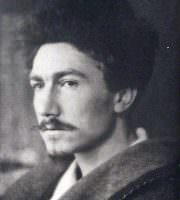
About Ezra Pound
Ezra Pound was an American expatriate famous poet, musician, and critic who was a major figure in the early modernist movement in poetry and who is often associated with the Lost Generation. He became known for his role in developing Imagism, which, in reaction to the Victorian and Georgian poets, favored tight language, unadorned imagery, and a strong correspondence between the verbal and musical qualities of the verse and the mood it expressed. His best known and famous poems include Ripostes and Hugh Selwyn Mauberley.Born in Hailey to a bourgeois family. Attracted early by poetry, he left for Italy in 1908. Upon his arrival in Venice, he published his first book, A Lume Spento, followed by Provença (1910), Canzoni (1911) and Ripostes (1912). Initially perceived as an English poet, he quickly became known in the United States through Harriet Monroe's magazine Poetry, for which he provided numerous texts. The following year, he moved to London, where he frequently frequented literary circles. During the following period, Pound strove to find the main directions of his art. In 1913, his Imagist manifesto appeared in the Poetry Magazine in Chicago. It was based on two essential principles: the direct presentation of the object taken as the theme and the primacy of rhythm, which must adapt to the melodic phrase. In 1914, he joined the “Vorticism” movement, which privileged energy, but an energy of balance, of immobility.
In 1931, the Objectivist program published by the Poetry Magazine set forth the main lines of Pound's system. Seduced by Italian fascism, Ezra Pound became infamous during the Second World War for his appearances on Roman radio, which were violently hostile to the United States and deeply anti-Semitic. Arrested by the Americans in 1945, he was imprisoned for some time. Once repatriated, he was tried and declared mentally ill. After spending a few years in a psychiatric hospital, he returned to Italy and died in Venice, without having completed his major work, the Cantos: a work in 116 sections considered a pinnacle of 20th-century poetry. Begun in 1904, the Cantos are the book of a lifetime, an unfinished 120-section epic poem. The result of tireless work, they strike an epic note: Pound nurtured the ambitious project of chronicling the entire history of humanity—present and past—and also, of course, his own history. From a wide variety of registers, this long poem may seem incoherent, but it presents a unity that links such disparate elements, synthesized by the constant exaltation of the virtues of the sage. The sections written at the end of World War II, published under the title The Pisan Cantos, received the Bollingen Prize in 1948. Through The Cantos, Ezra Pound profoundly influenced poets of his generation such as Hilda Doolittle and William Carlos Williams, the Objectivists Louis Zukofsky and Charles Reznikoff, and later Charles Olson and those of the Beat Generation, such as Gary Snyder and Allen Ginsberg.
Hemingway claimed that “the best of Pound's writing — which is in The Cantos — will last as long as there is literature.” He is therefore considered one of the most important and influential poets of the 20th century in the English-speaking world.
In poetry, Pound was a leading proponent of free versification. He played a major role in the modernist revolution in 20th-century English literature. As a critic and editor, Pound fostered the careers of William Butler Yeats, Richard Aldington, T.S. Eliot, James Joyce, Wyndham Lewis, Robert Frost, William Carlos Williams, H.D. Marianne Moore, Ernest Hemingway, D.H. Lawrence, Louis Zukofsky, Basil Bunting, George Oppen, and Charles Olson.
Browse all poems and texts published on Ezra Pound
Poetry is a sort of inspired mathematics, which gives us equations, not for abstract figures, triangles, squares, and the like, but for the human emotions. If one has a mind which inclines to magic rather than science, one will prefer to speak of these equations as spells or incantations; it sounds more arcane, mysterious, recondite.