
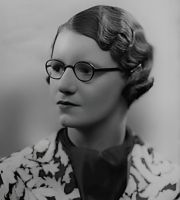
About G.E. Trevelyan
Gertrude Eileen Trevelyan, born on October 17, 1903, in Bath, Somerset, England and died on February 22, 1941, in Bath, was a British poet and novelist. Her first and only collection of poetry, “Julia, daughter of Claudius,” was published in 1927. At Oxford, where she studied from 1923 to 1927, she won the Oxford University Newdigate Prize for a 250-line poem entitled “Julia, daughter of Claudius”. She was the first woman to win this poetry prize. The subject of the poem is discussed in John Addington Symonds' book, “Renaissance in Italy”. During excavations on the Appian Way in 1485, a perfectly preserved body of a girl of about 15 years old was discovered. The body was taken to the Capitoline Hill, where it became the object of a cult that led the Pope to order its removal and secret burial. She told the “Daily Mail”, “I did it for fun,” since she had written little poetry before the competition.Her first novel, Appius and Virginia, was published by Martin Secker in 1932. Taking its title from a play by John Webster, the book tells of an experiment undertaken by an English spinster, Virginia Hutton, who sets out to raise an orangutan, Appius, as a human. His second novel, Hot-House, was published by Martin Secker in 1933. The book drew heavily on his experiences at Oxford, featuring an undergraduate student, Mina Cook, and her friendships. Reviewing the book in the Daily Mail, Compton Mackenzie wrote: “The whole thing is extremely well done and, by the time I finished it, the atmosphere of hot, humid air made me feel like an overfed gloxinia.” Her last novel, Trance by Appointment, was published by George G. Harrap in 1939. It tells the story of a working-class girl, Jean, who has visions which lead her to work as a fortune-teller and to marry an astrologer who gradually corrupts her powers.
G.E. Trevelyan was wounded in October 1940 when the Notting Hill apartment she lived in was damaged during the Blitz. She died of her injuries in Bath in February 1941.
Browse all poems and texts published on G.E. Trevelyan