About Hermann Hesse
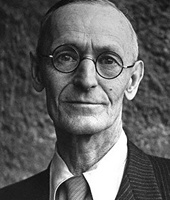
Hermann Hesse (1877-1962) was a German poet and writer, naturalized Swiss in 1923. Born in Calw (Württemberg), he grew up in a very pious family. After fleeing Count Maulbronn, where he was a seminarian, he worked in several professions, including journalism. In 1896, he published his first volume of poems, Romantische Lieder (Romantic Songs), and in 1904, his novel Peter Camenzind appeared. In 1911, he made a trip to India that was decisive for his literary career. After leaving his country, he changed his life and settled in Ticino, in Italy. There, he fought against the Nazis, wrote several works, and maintained an extensive international correspondence. In 1946, he was awarded the Nobel Prize for Literature. His work can be divided into three major periods: The novels of his youth (Peter Camenzind, Gertrud, 1910; Knulp, 1915) emphasize the opposition between aspirations for love and spirituality and the materialism of the modern world. The influence of Eastern wisdom appears in Demian (1919) and Siddhartha (1922), which affirm the desire for complete development through harmony and balance. Allegorical writing became more prominent in the third stage of his literary career: Steppenwolf (1927) shows the coexistence in human beings of the human soul and the wolf soul, of humanism and cruelty; Narcissus and Goldmund (1930) deals with the fusion of asceticism and enjoyment through the friendship that unites the monk Narcissus and the artist Goldenmouth; The Glass Bead Game (1943), which presents itself as a novel of anticipation, emphasizes the need to combine intellectual elements with sensual ones.Browse all poems and texts published on Hermann Hesse
Most people are like a falling leaf that drifts and turns in the air, flutters, and falls to the ground. But a few others are like stars which travel one defined path: no wind reaches them, they have within themselves their guide and path.