
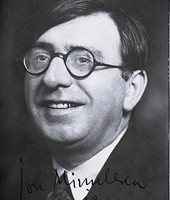
About Ion Minulescu
Ion Minulescu was a Romanian writer, born on January 6, 1881, in Bucharest, and died on April 11, 1944, in Bucharest. He is known as one of the main representatives of Symbolism in Romania, but also as a popular writer, his innovations often remaining playful and hardly falling into hermetic poetry. In 1897, he published his first poems, precisely under the pseudonym I.M. Nirvan, in the Pitesti magazine Povestea Vorbei. He continued in the following years to publish in various newspapers: Foaia pentru toti, Carmen, Evenimentul, among others.He enrolled in the Faculty of Law in Bucharest and then went to study in France from 1900 to 1904. However, he abandoned law to frequent the Parisian literary bohemia of the time, notably at the Vachette café. He became friends with a group of Romanian artists in exile: Gheorghe Petrascu, Camil Ressu, Jean Steriadi, Cecilia Cutescu-Storck, and met the actors Maria Ventura and Tony Bulandra. He also read a lot of the works of Jules Laforgue and Charles Baudelaire, on the French side, and Alexandru Macedonski on the Romanian side. He met the painter Demetrios Galanis, who introduced him to Jean Moréas, who, with his large black moustache and monocle, encouraged him to write, if he had talent, to write again, even if he did not know French well. In 1904, back in Romania, he frequented the Kübler café, where lively debates between traditionalists and modernists took place.
He began publishing in Ovid Densusianu's journal, Viata noua, and then especially in Ilarie Chendi's magazine, Viata literara si artistica, where his poems, entitled Celei care minte, presented as the translation of an Egyptian papyrus, were successful. This was also the beginning of his friendship with Dimitrie Anghel. Together, they published and popularized the works of French symbolist poets, such as Albert Samain, Charles Guérin, and Henri de Régnier. From a thematic point of view, after several stays in Constanta, it can also be considered that they introduced orientalism and seascapes into Romanian literature. In 1907, he participated in the literary Saturdays of Mihail Dragomirescu's cenacle, with Liviu Rebreanu, Mihail Sorbul and Emil Gârleanu. One of his poems, În orasul cu trei sute de biserici, published in Convorbiri Critici, Dragomirescu's magazine, was the subject of a letter of congratulations from one of the Romanian writers considered to be the greatest, Ion Luca Caragiale. The following year, on March 20, Minulescu launched his literary magazine, Revista celorlalti, opposed to the traditionalists, and of which he wrote the manifesto Aprindeti tortele! [Light the torches!] The magazine was only able to publish three issues, but Minulescu joined the staff of the magazine Viitorul and 1908 saw him publish his first two books: the collection of poems Romante pentru mai târziu (Romances for later) and the short stories Casa cu geamuri portocalii (The House with the Orange Windows).
He was featured in most of the notable histories of Romanian literature or panoramas of contemporary literature of the time. In 1927, Eugen Lovinescu made him the “flag-bearer of the Symbolist movement,” in 1924, Nicolae Iorga recognized “his immense and significant merit,” in 1941, George Calinescu, and in 1942, Serban Cioculescu also dedicated long articles to him. In 1928, he received the National Poetry Prize.
Browse all poems and texts published on Ion Minulescu