
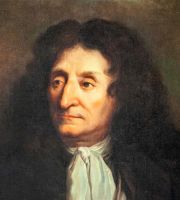
About Jean de la Fontaine
Jean de La Fontaine (Château-Thierry, Aisne, baptized July 8, 1621 – Paris, April 13, 1695) was a French poet and fabulist. His tales and novels were inspired by Ariosto, Boccaccio, François Rabelais, and Marguerite de Navarre. In 1683, he became a member of the French Academy.He began his literary career by adapting a comedy by the Roman playwright Terence, Eunuchus, this work, published in 1654, and considered as his principal published work went completely unnoticed. His second attempt, the poem Adonis (1658), was better received: praised by Nicolas Fouquet, the author became one of his numerous protégés. In 1661, while La Fontaine was writing The Dream of Vaux, a description of the Château de Vaux-le-Vicomte commissioned by the Superintendent of Finances, the latter was arrested. A year later, the poet had to pay a hefty fine for having improperly used the title of squire and left for Limousin. Back in Paris, he entered the service of the Dowager Duchess of Orléans as a gentleman squire (1664-1672). During this period, he wrote the Tales that appeared gradually between 1664 and 1671, published the first six books of Fables (1668), Psyche (1669), and eight New Fables accompanied by various poems (1671). After the Duchess's death, he was taken in by Madame de La Sablière (1672), in whose mansion he would remain for nearly twenty years. He then finished the second volume of the Fables, which would appear in 1678-1679, Saint Male (1673), the New Tales (1674) - whose sale was banned in 1675- and the satire of the Florentine that inspired his failed collaboration with Lulli. After having entered the French Academy in 1684 and having delivered, on that occasion, his Discourse to Madame de La Sablière, he published, in 1685, the Works of Prose and Poetry, a book that brings together fables, tales, ballads, madrigals, an imitation of Theocritus and several pieces inspired by Ovid. When Madame de La Sablière withdrew from public life to care for the sick at the Hospital of the Incurables, the poet was welcomed by the councilor of the Parliament of Paris, Mr. D’Hervart.
However, his literary fame rests on his Tales and Stories in Verse (1644), which was included by the Church in its Index of Prohibited Books in 1703 until its last edition in 1948. He was a member of a prominent French literary group that included the playwrights Molière and Racine, and the critic and poet Nicolas Boileau-Despréaux. His fables were published in numerous illustrated editions. In the mid-18th century, a multi-volume edition was released, with engravings based on designs by Jean-Baptiste Oudry. J. J. Grandville illustrated his fables in 1883. Gustave Doré, in 1867, and Benjamin Rabier, at the beginning of the 20th century. La Fontaine's fables revive the animalistic tradition, but considerably broaden its scope. They are a pretext for reverie, for digression, for reflection. They cover, in reality, all areas of the universe. This broad scope leads the author to develop themes such as nature, death, love, and the passage of time, which in some cases leads him to create a fantasy very close to the epic and to make this poetry a total poetry. La Fontaine—as he himself clearly states in the epilogue of the second book of Fables—believes he is listening to the manifold word of the universe. He did not invent the fable, nor did he imagine its themes, but he transformed the genre, making it true poetry. He forged a language full of subtlety beneath its apparent simplicity; he adopted a naive tone that reveals all the finesse of his thought; he expressed his fascination with all fictions, sources of poetry, revealers of creation; and he varied, endlessly, the tones, taking advantage of all the resources of expression and prosody. A clear evolution occurs in his style: from the first to the second book of Fables, he moves from a knowledge of nature inspired by Aesop, which is embodied in subtle descriptions of the landscape, to an Epicurean philosophy from which a personal art of living emerges.
Overwhelmed by illness, La Fontaine solemnly disavowed his Tales in 1693 and published the final book of his Fables that same year. He died, in an exemplary fashion, on April 13, 1695. La Fontaine's essential work, the Fables, reveals from beginning to end the vast erudition of its author. A voracious reader, he owed much to the writers of Antiquity: Homer, Virgil, Terence, Horace, Plato, Plutarch, Cicero, Demosthenes, and Livy were among his favorite sources of inspiration. 1.a La Fontaine employed a complete theory of imitation, which was essential to him: it was through imitation that he hoped to achieve originality.
But his attraction to the Greco-Romans did not distance him, however, from more modern literature: he was interested in Lastrea and in numerous French and foreign novels. Back in Paris, he entered the service of the Dowager Duchess of Orléans as a gentleman-squire (1664-1672).
Browse all poems and texts published on Jean de la Fontaine