
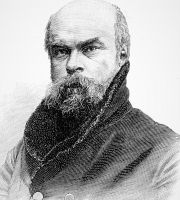
About Paul Verlaine
Paul Marie Verlaine (Metz, March 30, 1844 – Paris, January 8, 1896), known as Paul Verlaine, was a French lyric poet, initially associated with the Parnassians and later considered one of the main representatives of Decadentism and Symbolist movement. He is also recognized as one of the founders of modern poetry. Along with Stéphane Mallarmé and Charles Baudelaire, he formed the group known as the Decadents and is considered one of the leading figures of the fin de siècle in French and international poetry. His poems were marked by attention to rhythm, sound, and the sensitive projection of poetic images, and by a refusal to employ argumentative devices and rhetorical emotion, in the pursuit of pure poetry. Born in Metz, the son of a wealthy man, Verlaine attended the Lycée Bonaparte (now Lycée Condorcet) in Paris, and later began working as a civil servant. He started writing poetry early, and was initially influenced by Parnassianism and its leader, Charles Leconte de Lisle. Verlaine's first published work, “Poèmes saturniens” published in 1866, at the age of 22, despite negative criticism from Sainte-Beuve, established him as an original poet with a promising future.In terms of lyricism, Verlaine's work displays a diversity of tendencies that reveal a literary world where everything is mediated by metaphor and allegory. One of the most purely lyrical French poets, Verlaine was an initiator of modern word-music and marked a transition between the Romantic and Symbolist poets. His best poetry broke with the sonorous rhetoric of most of his predecessors and demonstrated that the French language, including everyday clichés, could communicate new nuances of human feeling through suggestion and a tremulous vagueness that captivates the reader by disarming their intellect: words could be used simply for their sound to create a more subtle music, a more potent spell than their everyday meaning. Explicit intellectual or philosophical content is absent from his best work. His discovery of the intimate musicality of the French language was undoubtedly instinctive, but, during his most creative years, he was a conscious artist who constantly sought to develop his unique talent and “reform” the poetic expression of his nation.
His life was turned upside down when he met Arthur Rimbaud in September 1871; their tumultuous and wandering love life in England and Belgium led them to a violent scene: in Brussels, Verlaine, with a revolver, injured the wrist of the man he called his “infernal husband.” Verlaine was tried and convicted, spending two years in prison, reconnecting with the Catholicism of his childhood and writing poems that appeared in his subsequent collections: Sagesse (1880), Jadis et Naguère (1884), and Parallel (1889). Worn down by alcohol and illness, Verlaine died at the age of 51 on January 8, 1896, from acute pneumonia. He was buried in Paris in the Batignolles cemetery.
Browse all poems and texts published on Paul Verlaine