
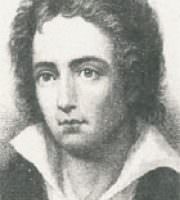
About Percy Bysshe Shelley
Percy Bysshe Shelley (August 4, 1792–July 8, 1822) was one of the famous english romantic poets. Shelley did not see fame during his lifetime, but recognition for his poetry grew steadily following his death. While anthologies mainly include “Ozymandias”, “Ode to the West Wind”, “To a Skylark and The Mask of Anarchy”, his most important works are long visionary poems such as “Alastor”, or “The Spirit of Solitude”, “Adonais”, “Prometheus Unbound”, and his unfinished poem “The Triumph of Life”. His fame is also associated with that of his contemporaries John Keats and Lord Byron, who like him died young, as well as with the woman he married in his second marriage, the novelist Mary Shelley, author of Frankenstein, whose 1818 edition he prefaced.As a member of a wealthy and noble family, he learned Latin from the age of six and developed a passion for literature. Tired of his father's authoritarianism and no longer able to endure the rigidity of Eton—where, thanks to his studies, he acquired a solid classical education—he moved to University College, Oxford, in 1810 and began his literary career by writing several poems and two Gothic novels: Zastrozzi and Saint Irvyne or the Rosicrucian. In 1811, he was expelled from Oxford for publishing a pamphlet entitled “The Necessity of Atheism”. He then went to London, where he met a sixteen-year-old girl, Harriet Westbrook, whom he married in Scotland. In 1812, he traveled to Ireland and became an enthusiastic supporter of the nationalism being promoted there. A year later, he finished “Queen Mab”, a political poem in which he criticized the society of his time and expressed his hope for a utopian future. In 1814, he fell in love again with a young woman, Mary Godwin. In 1816, he traveled with her to Switzerland, where he met Byron; there he composed Alastor, or The Spirit of Solitude, in which he attempted to demonstrate that man's sole purpose is communication with others. He returned to London and learned of his first wife's suicide. He then married Mary on December 30, 1816. Suffering from tuberculosis, he decided to leave his homeland permanently and settle in Italy, residing successively in Rome, Milan, Florence, Pisa, and Ravenna. It was then that his inspiration reached its zenith. In 1818, “The Revolt of Islam”, a narrative poem in twelve cantos, was published, in which Shelley's three favorite themes are developed: the search for connection with others, the importance of love, and the fragility of freedom. In 1819, the five-act tragedy “The Cenci” was published, in which the protagonist, Beatrice, orders the murder of her father to escape his incestuous love and free those around her from his despotism. The following year, “Prometheus Unbound”, Shelley's most important work, was published. Presented in the form of a lyric drama, it recovers the theme of Aeschylus, but considerably modifying its meaning and treatment.
Also in 1820, his most celebrated poems appeared: “Ode to the West Wind”, “The Cloud”, and “Ode to a Lark”, where lyricism and cosmic dimension overlap. The last years of his life were also very fruitful: in 1821, Shelley finished Epipsychidion, an autobiographical poem dedicated to Emilia Viviani, and Adonais, inspired by the death of Keats. In 1822, he completed Hellas, a lyrical drama about the Greek uprising, before drowning while on a yacht trip at the age of thirty.
Browse all poems and texts published on Percy Bysshe Shelley
Poetry is the record of the best and happiest moments of the happiest and best minds.