About Robert Browning
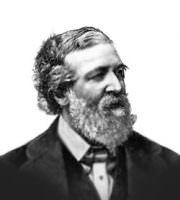
Robert Browning was an English poet and playwright, born on May 7, 1812, in Camberwell (Surrey) and died on December 12, 1889 in Venice. He was born the same year as Dickens and is now recognized as one of the two greatest poetic creators of Victorian England, the equal, although in a completely different style, of Tennyson. His most important works are the collections “Dramatic Lyrics”, “Dramatic Romances and Lyrics”, and “Men and Women”, which is considered the masterpiece of his maturity, and also “Dramatis Personae”, and the narrative poem “The Ring and the Book”.His poems are known for their irony, characterization, dark humor, social commentary, historical settings, and challenging vocabulary and syntax. He is also best known for his poems “My Last Duchess”, “Porphyria's Lover”, “How They Brought the Good News from Ghent to Aix” and “The Pied Piper of Hamelin”.
He was educated in a more refined environment; he acquired, above all, through his self-education and thanks to an insatiable intellectual curiosity, a broad and original culture. However, He was never a popular author, but in the last years of his life he was enthusiastically revered, and several literary circles were created to study his work. He lived for a long time in Italy, especially in Florence from 1846 onwards, and during the fifteen years of his romantic and exceptionally happy relationship with Elizabeth Barrett Browning.
Robert Browning's early works (Pauline, 1833; Paracelsus, 1835) went unnoticed, and his dramatic attempts failed. But his great collections of poems soon followed: Sordello (1840), Bells and Pomegranates (1841), Men and Women (1855), and The Ring and the Book (1868-1869).
Browning poetry showed great originality; his rhymes and syntax had an aggressively experimental character. He adopted the dramatic form and made it a powerful means of poetic expression. In short, he dedicated himself to a vast psychological exploration. He places his characters in antiquity or in distant lands, and seems, in this respect, little concerned with contemporary problems. However, he once declared that he had “insisted on the incidents that mark the development of a human soul; there are very few other things that deserve to be studied.” For him, the human soul, regardless of environment and era, is unique. Browning, finally, gave repeated proof of great insight in the analysis and reconstruction of certain individuals.
Browse all poems and texts published on Robert Browning
To do good things in the world, first you must know who you are and what gives meaning to your life.