
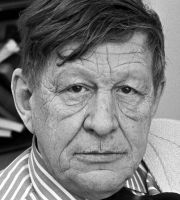
About W. H. Auden
W. H. Auden (York (United Kingdom), February 21, 1907 – Vienna (Austria), September 29, 1973) was an English poet and playwright, naturalized American. He received a solid scientific training before achieving, in the literary arena, a leading role between 1930 and 1940. He is regarded by many critics as one of the greatest writers of the 20th century. A Marxist in his early days, he wrote true combat poems, denouncing corruption and calling for revolution: Poems (1930), The Orators (Faber and Faber, 1932), and The Dance of Death (1933). He evolved slowly and eventually found in Kierkegaard the philosophical foundation he had lacked. This change in his value system led him to exile to the United States in 1939, and to convert to Catholicism a year later. Despite being severely criticized for his ideological deviations, he never abandoned his humor or his satirical spirit.In 1945, one of his key poems appeared, The Sea and the Mirror, in which Prospero and Caliban (characters in Shakespeare's The Tempest), Evil and Love, engage in a dialogue without limits. In that same year, he published For the Time Being, a Christmas Oratorio, in which the eras of the poet—the repository of an extremely rich cultural past—and the thinker—who reclaims mythical times in the face of a cold and dehumanizing present—are anachronistically intertwined. We thus arrive at The Age of Anxiety: A Baroque Eclogue (Random House, 1948), whose evil is, more than ever, the loneliness of man. The final stage of Auden's literary career—the one that runs from The Shield of Achilles (1955) to About the House (1965)—appears somewhat confusing: it is as if its purpose were now to entertain. Let us not forget, however, that this Proteus of writing had confessed, in his book of essays The Dyer’s Hand and Other Essays (1962), that all his poems were love poems; that is perhaps, besides his talent, the only constant throughout his work.
Auden benefited from a strong resurgence in notoriety in 1994 following the reading of his poem Funeral Blues by one of the characters in Mike Newell's film Four Weddings and a Funeral. The first version of the poem, published in 1936, is satirical: sung by two of the protagonists of the play The Ascent of F6 at the death of another character, it mocks with disgust the hypocrisy of state funerals. In 1938, Auden rewrote this poem, retaining the first two stanzas, as a love song intended to be sung by a soprano friend of his, Hedli Anderson.
His work is noted for its stylistic and technical achievement, its engagement with moral and political issues, and its variety in tone, form, and content. The central themes of his poetry are love, politics and citizenship, religion and morals, and the relationship between unique human beings and the anonymous, impersonal world of nature.
He was elected Chancellor of the Academy of American Poets in 1954. He held this office until his death in 1973.
Browse all poems and texts published on W. H. Auden
A poet is, before anything else, a person who is passionately in love with language.