
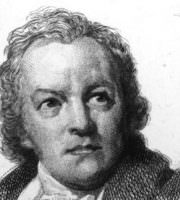
About William Blake
William Blake (November 28, 1757–August 12, 1827) was an English poet and artist. Even he was largely unrecognized during his lifetime, Blake is now considered a seminal figure in the history of the poetry and visual arts of the Romantic Age. His prophetic poetry has been said to form what is in proportion to its merits the least read body of poetry in the English language. At a young age, he learned the art of engraving. This is how he began to practice this craft and illustrate his own works, adding another dimension to them.His career is divided into three major periods: from his adolescence until approximately 1804, it is in this period which he sought his own path. He devoted himself to lyric poetry with “Songs of Innocence and of Experience” (1789-1794), in which he adopted the form of the engraved book, whose text and illustration appear intimately linked. Between 1800 and 1803—the period of his stay in Sussex with the poet Hayley—this search reached its full development. Meanwhile, he has already begun to reveal his prophetic inspiration, with America a Prophecy (1793), Europe a Prophecy (1794), the First Book of Urizen (1794), the Book of Los (1795), Vala or The Four Zoas (1797), Milton (which begins in the year 1804), or Jerusalem: The Emanation of the Giant Albion (whose writing also begins in 1804).
A second period, from 1804 to 1820, marks the time of his retreat and reflection. Blake withdraws from the world to take stock after this intense creative activity. He then completed Milton (1818) and Jerusalem (1820). In 1809, he exhibited his engraved work and, in the descriptive catalogue of that exhibition, developed his conceptions of this medium of expression.
In the third stage, from 1820 to 1827, Blake reaches the end of his evolution. The graphic element is for him the most important, and he eliminates the creation of text. It is the triumph of visual contemplation, with the woodcuts illustrating Virgil, the engravings of the Book of Job (1825), and the series of watercolors inspired by Dante's Divine Comedy (1825-1827).
One of Blake's great originalities, then, is having associated verbal poetry and graphic poetry. For him, these are not two separate modes of expression, nor even complementary ones. He conceives of them as inseparable manifestations of a single, shared inspiration. Image and word appear closely related. From all of this emerges a kind of technical unity in the “book-object,” a creation characterized by a totality that is imbued with a sacred function. A visual coherence derives from the symbol, while at the same time a mythical expression is created, arising from the amalgamation between the sign and the signified vision. Blake's mythology also engenders a fusion between the lived and the spiritual, between the movement of history and the permanence of tradition. The American Rebellion, the French Revolution, and the figure of Napoleon contribute their elements. The Bible, the Kabbalah, Milton, Locke, or Newton exert their influence.
In this way, a representation of the world is configured: a cruel God, from the Old Testament, whom Blake calls Urizen, represents sterilizing reason and the oppression of power. Christ personifies the eternal and positive poetic genius. Man finds himself at the crossroads of these two forces, of this spiritual epic. Blake rejects, therefore, the intellectualist solution; nor does he adhere to the vision of the Romantic artist. He is, in truth, the initiator of supernaturalism; this is what would explain the essential place he grants to vision. Imagination also plays a determining role in this trajectory: it is the instrument of the conquest of art and, therefore, of eternity. It is what attempts to unite the three times of contemplation, which are nostalgia, presence, and hope. Bursting first into multiple elements, imagination reaches its fullness in unity, progressively dispensing with the word in favor of the image.
Browse all poems and texts published on William Blake
To see a world in a grain of sand
And a heaven in a wild flower,
Hold infinity in the palm of your hand,
And eternity in an hour.