
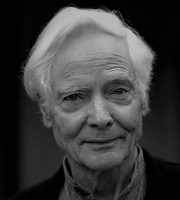
About William Stanley Merwin
William Stanley Merwin, also known as W. S. Merwin (September 30, 1927 in New York City, New York – March 15, 2019 in Maui, Hawaii) was an American poet, writer, and translator who twice received the Pulitzer Prize for poetry. He is the author of more than twenty-five volumes of poetry, two dozen books of translations, eight works of prose, and several verse plays. Born in New York, Merwin studied literature and romance at Princeton University. After his studies he traveled through France, England and finally Spain, where he taught Robert Graves son on Mallorca in 1950. From 1951 he worked as a translator in London before returning to America, where he devoted himself to poetry. His first book, The Mask of Janns, was selected by W. H. Auden for the Yale Series of Younger Poets Prize in 1952. In the late sixties Merwin, a committed pacifist, began to write poems protesting the Vietnam War, and in 1971 he refused to accept the money for his first Pulitzer Prize and published a letter to the New York Review of Books saying that he would donate the money to antiwar causes. Other volumes of poetry followed in the stylistic tradition of Wallace Stevens and Robert Graves, among others.In the 1960s, Merwin began experimenting with lyrical forms, which he theoretically supported in essays such as On Open Form (1969). Themes from his own life increasingly came up, such as in 1960 in The Drunk in the Furnace. In 1971, he received the Pulitzer Prize for The Carrier of Ladders, published the previous year, but declined the trophy in protest of the Vietnam War. His autobiography The Miner's Pale Children was also published in 1970. Merwin spent his late years in Hawaii, where his poetry pays special attention to nature. However, he was known for his poems, which, like those of Robert Bly, Adrienne Rich, Allen Ginsberg and Yusef Komunyakaa, dealt with the Vietnam War. He is also considered one of the most outstanding translators of Spanish-language poetry into English, having published English versions of works by Federico García Lorca and Pablo Neruda (Twenty love poems and a desperate song), among other authors. In 1977, he also received the Bollingen Prize for Poetry. He was inducted into the American Academy of Arts and Letters in 1972 and the American Academy of Arts and Sciences in 1993. In 2005, he was awarded the US National Book Award for his work Migration: New & Selected Poems.
Following the verse novel Folding Cliffs: A Narrative, published in 1998, further memoirs were published in 2006 under the title Summer Doorways. He resided in Maui, Hawaii, and received his second Pulitzer Prize for Poetry in 2009 for The Shadow of Sirius. As of fall 2010, he was the 17th Poet Laureate in the United States. He was the successor to Kay Ryan.
Merwin was once asked what social role a poet plays—if any—in America, fie commented: “I think there’s a kind of desperate hope built into poetry now that one really wants, hopelessly, to save the world. One is trying to say everything that can be said for the things that one loves while there’s still time. I think that’s a social role, don’t you?... We keep expressing our anger and our love, and we hope, hopelessly perhaps, that it will have some effect. But... one can’t live only in despair and anger without eventually destroying the thing one is angry in defense of. The world is still here... and there is a need to pay attention to the things around us while they are still around us. If you don’t pay that attention, the anger is just bitterness.” W. S. Merwin died on March 15, 2019, at age 91 at his residence in Hawaii.
Browse all poems and texts published on William Stanley Merwin
Poetry is a way of looking at the world for the first time... Prose is about something, but poetry is about what can't be said. Why do people turn to poetry when all of a sudden the Twin Towers get hit, or when their marriage breaks up, or when the person they love most in the world drops dead in the same room? Because they can't say it.