
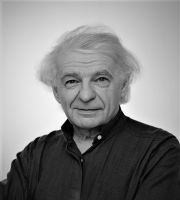
About Yves Bonnefoy
Yves Bonnefoy (June 24, 1923 in Tours — July 1, 2016 in Paris) was a French poet, author, translator and university professor. He studied mathematics and philosophy in Tours, Poitiers, and at the Sorbonne in Paris. After World War II, he studied art history and traveled throughout Europe and the United States. As early as 1944, he joined the Surrealists, which particularly influenced his first work, “Traité du pianiste”, published in 1946. In the same year, he founded the journal “La Révolution, la Nuit”. From the early period of his career come the poetry collections “On the Motion and Immobility of Douve” (1953), “Yesterday Reigning Desert”, and “Written Stone”, published in France between 1953 and 1965. In 1967, together with André du Bouchet, Gaëtan Picon, and Louis-René des Forêts, he began publishing the art and literary journal “L'éphemère”. His poems and essays on art, especially paintings, made him a well-known figure in the 20th-century literary world. His 1972 work, L'Arrière-Pays (“The Hinterland”), occupies a special place among them.He bestows a sacred character upon poetry: the enchanting power he grants to expression, its restrained sensitivity, its harmonious musicality, a strange intellectual density constituted the success of On the Motion and Immobility of Douve. From then on, the poet gradually strips himself away: Yesterday Reigning Desert (1956), Written Stone (1961). Austere poetry, which brings forth from an “inland” (title of an essay published in 1972) a language crafted in solitude, on the borders of death. Bonnefoy delights—through the work of Rimbaud (1960) or in theoretical essays—in reflecting on the process of poetic creation, thus showing that, in his work, nothing is accidental.
Bonnefoy's poetry is often difficult to access; each individual poem can only be understood in relation to his complete works. “I don't write poems in the sense that the word 'poem' denotes a self-contained, independent entity,” Bonnefoy stated in 1972. “What I write are rather entireties, assemblages, contexts, within which each individual text is only a fragment.”
Bonnefoy was considered one of the most important French poets of his time. Furthermore, his translations into French, especially those of various works by Shakespeare, including the sonnets, have received widespread acclaim. He also published several books on art and art history, including works on Miró and Giacometti. Bonnefoy was honoured with a number of prizes throughout his creative life. Early on, he was awarded the Prix des Critiques in 1971. Ten years later, in 1981, The French Academy gave him its grand prize, which was soon followed by the Goncourt Prize for Poetry in 1987. Over the next 15 years, Bonnefoy was awarded both the Prix mondial Cino Del Duca and the Balzan Prize (for Art History and Art Criticism in Europe) in 1995, the Golden Wreath of Struga Poetry Evenings in 1999, and the Grand Prize of the First Masaoka Shiki International Haiku Awards in 2000. Toward the final years of his life, Bonnefoy was recognized with the Franz Kafka Prize in 2007 and, in 2011, he received the Griffin Lifetime Recognition Award, presented by the trustees of the Griffin Poetry Prize. In 2014, he was co-winner of the Janus Pannonius International Poetry Prize. He won the 2015 International Nonino Prize in Italy.
In 2001, he was elected an honorary foreign member of the American Academy of Arts and Letters. In 2011, he was elected to the American Academy of Arts and Sciences.
Browse all poems and texts published on Yves Bonnefoy