About Amiri Baraka
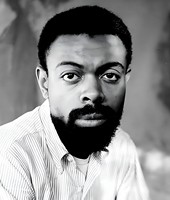
Everett LeRoi Jones, known by his pseudonym Amiri Baraka, was born on October 7, 1934, in Newark, New Jersey, and died in the same city on January 9, 2014. He was an American playwright, novelist, short story writer, poet, essayist, editor, and university professor. He is the founder of the Black Arts Movement. At the forefront of a form of engaged aesthetics, Amiri Baraka championed an African-American aesthetic freed from the hegemony of Western cultural canons.From elementary school onward, he showed a literary curiosity, devouring the works of Charles Dickens and Rudyard Kipling as a young man, and as his father reported in an interview, “He read everything he could get his hands on.” When he was only eight years old, his parents caught him reciting by heart the Gettysburg speech delivered by President Abraham Lincoln in 1863.
Jones joined the U.S. Air Force in 1954, reaching the rank of sergeant. After an anonymous letter denouncing his alleged communist beliefs to his superiors, he received a reprimand for violating his military oath and was assigned to the kitchen. That same year, he left the army and went to Greenwich Village, the "Bohemian” neighborhood of New York, where he discovered jazz and the movement of the “Beat Generation” poets, such as Allen Ginsberg, Frank O'Hara, Gilbert Sorrentino, and Charles Olson, who greatly influenced his own poetic and dramatic work. Jones became one of the neighborhood's most notorious dandies. In 1958, he founded the publishing house Totem Press, which published the works of Beat Generation icons such as Jack Kerouac and Allen Ginsberg. That year also saw his marriage to Hettie Cohen Jones, with whom he would co-edit the literary magazine Yugen until 1963.
In 1960, he traveled to Cuba, a visit that transformed him into a much more politically engaged artist. In 1961, he published Preface to a Twenty Volume Suicide Note, followed in 1963 by Blues People: Negro Music in White America, which remains today considered one of the most influential critical works on the subject of blues and jazz. In 1964, Jones achieved great success with his play Dutchman, which earned him an Obie Award.
Following the assassination of Malcolm X in 1965, Jones broke with the Beat poets, left his wife and their two children, and moved to the Black New York neighborhood of Harlem, joining the Black nationalist movement. In the process, he founded the Black Arts Movement with the opening of the Black Arts Repertory Theater in Harlem in 1965, which was the cultural and aesthetic counterpart of the Black Panther Party political movement.
His greatest contribution to the Black Power movement was the book Blues People, in which he developed the revolutionary thesis that the changing status of African Americans was echoed in changes in African American music. His social and political interpretation of blues and jazz has had a significant influence on the field of Popular Music Studies.
As a visiting professor, he taught African American culture and literature at Columbia University, and later held a full-time professorship at Rutgers University. In 1987, he participated with Toni Morrison and Maya Angelou in the James Baldwin memorial service. In 1998, he played the character of Rastaman in Warren Beatty's film Bulworth. He has received numerous honors and distinctions, including being inducted into the American Academy of Arts and Letters in 2001.
He died of post-operative complications at Beth Israel Medical Center in Newark on January 9, 2014, where he had been hospitalized since December 21, 2013.
Browse all poems and texts published on Amiri Baraka