
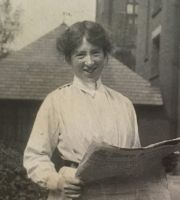
About Winifred M. Letts
Winifred Mabel Letts was an English poet, novelist, children’s writer and playwright who spent most of her life in Ireland. She was born in 1882 in Salford, in what is now Greater Manchester in England, and raised and educated in Bromley. Her first poetry collection, “Songs from Leinster”, was published in 1913. The book shows that Letts, despite her English birth, was positioning herself definitively as an Irish author. The collection opens with a poem entitled “The Harbour” which implies that Letts was a native of Wexford. The heartfelt and seemingly autobiographical nature of the poem has meant that one still regularly sees scholarly works that assert that Letts was born in that county. Within the collection’s most celebrated poem – “The Spires of Oxford (Seen From a Train)” – Letts reflects on the tragic loss of a generation of young men with promising futures.At the beginning of her literary career, Letts focused primarily on writing plays and children's fiction. In 1907, she had her first play produced at the Abbey, The Eyes of the Blind, and her first works of fiction published, The Story-Spinner and Waste Castle. Throughout her life, Letts would write two more other plays, The Challenge, produced at the Abbey in 1909, and Hamilton and Jones, produced at the Gate Theatre in 1941, and she would publish fourteen more books for children. However, it was as a poet that she found her greatest fame. While certain critics have rightly pointed out that Letts’s poetry targets the mainstream audience and varies in quality, it is undeniable that she wrote some of the most unforgettable and known poems from the Irish Revival era. Her poem The Deserter (written in 1916), describing the feelings and fate of a man terrified by the war, is often used in collections of World War I poetry. “Songs from Leinster” also includes six poems that were set to music by the renowned Irish composer Charles Villiers Stanford, featuring the well-loved song “A Soft Day”. Among the poems, two pay homage to the distinguished artists of the early Abbey, specifically “For Sixpence” and “Synge’s Grave”. It is also important to note that the volume wraps up with “The Christmas Guest” – one of three significant poetic tributes to the Virgin Mary that Letts wrote during her lifetime, with the other two being “Rosa Mystica” and “Our Lady of the Lupins”, both from 1916. What makes this particularly fascinating is that Letts, who published under the names “W.M. Letts” or “Winifred M. Letts”, doesn't appear to have corrected the prevalent belief that her middle initial “M” stood for Mary. (Her birth certificate confirms that her middle name was, in reality, Mabel.) At this point, we cannot determine if the confusion originated with Letts herself. However, by not contesting the idea that the “M” represented “Mary”, Letts may have been enhancing her Irish persona by (in a way) adopting a name commonly associated with Irish Catholics – and, in fact, Irish Protestants. Furthermore, the term “name change,” the three poems dedicated to the Virgin Mary, the reference to the Angelus in “The Harbour,” and the “lives of the saints” she developed for children and adults all point to Letts having a “transgressive” interest in the symbols and language of Roman Catholicism – a fascination that was common among numerous Irish Protestant writers in the late nineteenth and early to mid-twentieth centuries.
She worked as a nurse during the First World War: as Voluntary Aid Detachment nurse in 1915 at Manchester Base Hospital, and her groundbreaking poetry collection, Hallowe'en and Poems of the War, was published in 1916. Later, she joined the Almeric Paget Military Massage Corps, working at Command Depot Camps in Manchester and Alnwick. She married W. H. Foster Verschoyle, and lived in Dublin in the 1930s, and in Faversham, Kent, in the 1940s.
Browse all poems and texts published on Winifred M. Letts