
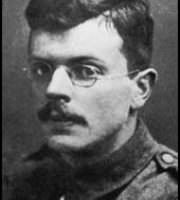
About Ivor Gurney
Ivor Gurney (28 August 1890 – 26 December 1937) was a British poet and composer, considered one of the greatest poet-soldiers of the First World War. Belonging to the canonical group of “War Poets” (English poets of the First World War), and like the others of them, such as Edward Thomas whom he admired, he often contrasted the horrors of the front line with the beauty and tranquility of his native English landscape — these themes were explored in the 2012 musical play “A Soldier and a Maker”. Among his best-known works are the poetry collection Severn and Somme (1917) and his orchestral piece War Elegy (1920).Ivor Gurney also composed some two hundred songs, as well as pieces for chamber and orchestra, and more than eight hundred poems. Among his best-known compositions are his “Five Elizabethan Songs (1913–1914)”, and his numerous settings of poems by contemporary poets: A.E. Housman (poems set to music in Ludlow and Teme and The Western Playland); Edward Thomas (Lights Out); and W.H. Davies. Gurney also set his own texts to music, the most celebrated of which is “Severn Meadows.” Gurney published two collections during his lifetime: Severn and Somme and War's Embers. However, several posthumous works exist that bring together his postwar poems, largely written while in a mental asylum.
Among his best-known poems are: “To His love”, “First Time In”, “Laventie”, “We Somme”, “Bread”, “Servitude”, “Strange Hells”, “The Hills Have a Bitterness”, “The Silent One”, and “It is Near Toussaints”.
Browse all poems and texts published on Ivor Gurney
There are strange hells within the minds war made.